


Irvine Welsh: “Athletic’s philosophy is amazing”
Irvine Welsh: “Athletic’s philosophy is amazing”
The renowned Scottish author of ‘Trainspotting’ lived up to his reputation and style during his conversation with Basque writer Amets Arzallus
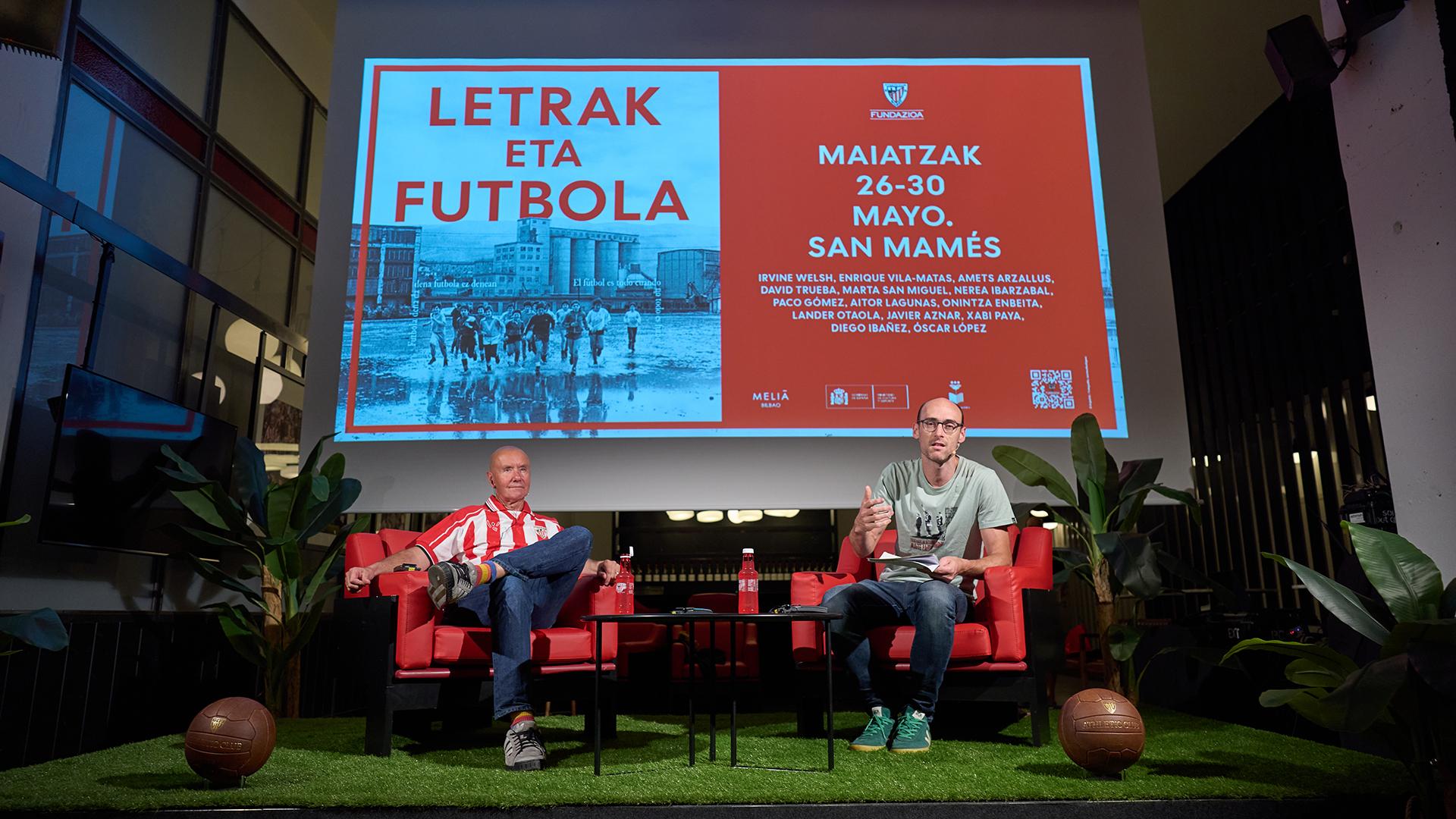
There was a great deal of anticipation surrounding Irvine Welsh’s appearance at this year’s Letters and Football festival, and the renowned Scottish writer did not disappoint. True to his reputation and his half-serious, half-punk style, he took to the stage wearing an Athletic shirt and radiated energy in every one of his comments and reflections.
At Irvine's side, the Basque poet Amets Arzallus skilfully grilled him, using his incisive questions to elicit the Scottish writer's trademark responses: anti-authoritarianism, marginalisation, feminism, masculinity, addiction, survival, working-class football, identity, capitalism and, above all, that intelligence of someone who has no desire to sugar-coat reality, but rather to portray it starkly, albeit with all its chaotic, humorous and nihilistic nuances.
When asked about his earliest memory of football, Welsh recalled family memories and, in particular, the time when, at the age of nine, he attended a Hibernian FC match in which several memorable goals were scored. It was a spectacular match, which he compared to this season’s thrilling Champions League clash between PSG and Bayern
As a Hibernian fan (it is worth noting that Athletic Club presented Hibs player Joelle Murray with the One Club Woman 2025 award), Welsh highlighted football’s power to foster a sense of community and to serve as a visible, constant presence that brings people together. “This is particularly evident, for example, amongst the working class in Scotland,” he said.
Speaking on the subject of a club’s connection with its community, he praised Athletic’s bond with its supporters and added that this is perhaps something being lost in modern, globalised football. On the subject of the club’s philosophy, he said he found it a romantic idea, “something truly outstanding that I wish would happen in more places”.
Football, masculinity and feminism were also part of the conversation, with Welsh declared himself a feminist whilst acknowledging that there is still a long way to go.
As might be expected, Welsh was highly critical of capitalism, not only for its negative influence on football, but on humanity in general.
To conclude, Arzallus asked Welsh about the 1978 World Cup in Argentina and the famous scene in 'Trainspotting' in which Renton describes the high from heroin as something “better than Archie Gemmill’s goal against the Netherlands”. The Scottish writer recalled that corruption and sport have always been intertwined and that, unfortunately, political leaders have always tried to use football to their advantage.
With San Mames's Sala Este packed to capacity, and following a farewell poem by Amets Arzallus, the audience – which included Jose Angel Iribar – gave Irvine Welsh a standing ovation.